Orthodoxy and Chai in İstanbul’s Greek Neighborhood

I spent my third day in Istanbul walking slowly through neighborhoods. I walked down a hill and found myself drifting into a coffee shop. Without speaking a word I ordered a spiced chai and was taken to a table across the street. Sitting down, I found myself within an environment I was slowly getting used to. I saw a series of plastic tables sprawled across the pavement, occupied by men of different classes who seemed unbothered by the morning’s rising heat and increasingly loud traffic. Inside, was the sound of steaming coffee and fast conversation.

The air was melting in the heat while a pudgy Turkish kid wearing a t-shirt one size too small bounced between tables pitching an idea that nobody seemed amused by. I locked eyes with the dealer, probably no older than 10 years old, as he approached me. In his palm was a pack of gum, laid across his fingers as if it were a delicacy. The boy spoke as if he were not only selling a product but a lifestyle, yet within his passionate words, the only syllables I could understand were “five lira, five lira.” 

It was not uncommon to have a moment of peace disrupted by a salesman in Istanbul, but I had yet to meet one who was as convincing as this kid. So, we worked out a deal and I made an investment of 10 Lira, which is 37 cents in USD, for his pack of gum. After the transaction, the boy paraded his 10 Lira around the coffee shop as if it were a holy relic. Repeatedly, he would tell an uninterested group of men, they would turn to me with half a smile, and the young Turk would put his hand to his chest as a sign of thanks. Unbeknownst to me, mass had begun down the road.

Continuing my wandering, I came across a Greek Orthodox church. At this point in my travels, their pillars had a warming familiarity compared to the minarets of Sunni Mosques. My Papou (Greek for grandpa) has been proud to share the heritage with me since I was young. So, while the Greek language is as foreign to me as Arabic or Turkish, it felt like a step closer to a world I knew.

Beyond a steel gate was a courtyard where a man and a woman stood talking to one another. I waved to them and they motioned for me to come in, so I did. They watched as I approached and the woman smiled before gesturing toward the church entrance. Mass had already begun within. 

I found myself standing amongst twelve others whose eyes were trained on the priest who was leading prayer in his deep melodic voice. Following his prayer, the congregation formed a single file line toward the altar. Then, one by one I watched the devotees kiss the hand of their father and take a loaf of bread wrapped in parchment from a wicker basket. I had come this far, so I joined everyone else in line. However, when I reached the heavily bearded Orthodox priest I did not grab his hand and kiss his white knuckles, instead, I did what seemed like the second most appropriate thing to do: a formal bow, which in turn felt really corny. I grabbed my loaf of bread and followed the crowd outside.

Istanbul is many things, but parts of it are far from relaxing. The courtyard of the Orthodox Church, however, transported me to a place free from streets clouded by cigarette smoke and the radiation of roasting shawarma. It was quiet and somehow a breeze had carved its way in over the walls. I was not ready to leave a place that had given me a breath of fresh air, and it seemed neither was anyone else. I sat on a bench and watched the parishioners talk with one another in the shade. The mid-day sun had speared through a tree above our heads, illuminating the greenness of its leaves. In another corner of the courtyard was a tiny gatehouse with vines growing up to decorated windowsills. It looked like it belonged in a small Greek village near the Aegean Sea. 

The woman who had invited me inside emerged from the gatehouse carrying a tray of pastries. She made eye contact with me and using her head, the only extremity available to do so, she directed me to join the rest of the bunch. As the croissants and sweets arrived, the crowd floated to a long table beneath the tree. An organized movement of chairs indicated that this sort of meeting had happened many times before. Similarly, tea was poured and handed out as if I had ordered it moments earlier. I sat in silence, sipped my chai, and watched. Things continued to unfold without moving an inch. I knew all of this would make a lot more sense if I just wasn’t there. I remembered earlier how the little boy I had bought gum from put his hand on his chest as a sign of thanks and so I followed suit in an attempt to communicate some sort of gratitude. 

The priest came out from his chambers and sat across from me along with other holy-looking men. They all wore big black robes and had the facial hair to go with it. People continued to fill chairs, yet the one next to me remained open. The woman on pastry duty seemed to also be the social director. She pointed to people and ordered them to sit in certain places. Eventually, she instructed someone to sit next to me. I saw him walking over and I became tense. A conversation was on the horizon, I hadn’t had one of those all day. 

It was a man in his early thirties, with short brown hair and a casual stature. He sat down and said, “hey how’s it going,” with an excited energy as if we’d known each other in high school. Harry was the only American I met in Turkey and we came across one another in the strangest of circumstances. 

“It’s the best place in the world, we are literally in the middle of the world,” said Harry with an equal amount of animation in his hands and eyes. I became inspired and intrigued by his passion for that place and the ideas that circulated there. I had many questions and he had many answers, thus we were bound to spend the next hour sipping tea in the courtyard.

Harry was right. Every location is the sum total of its influences, and Istanbul has many. We were on the edge of Europe. Sitting at the edge of that table I tried to imagine Istanbul sitting in the middle of the crossroads and all the visitors who had passed through for hundreds of years. However, that day, sitting back in our chairs in the year of 2023 while slowly and reverently drinking our chai, our topic of conversation circled around Turkey and its recent history.

Harry had arrived by bus from Thessaloniki where he was learning the Greek language. I learned that he had studied theology in the States, contributing to an encyclopedia’s worth of knowledge on the subject. He had even spent time in the monasteries of Mount Athos, a region of Greece dedicated to strict Orthodox practices. This pursuit was inspired by his Greek heritage and faith. Now, he had come to Istanbul to retrace the steps of his grandfather. 

His grandfather’s name was Christos Daphnides. Christos grew up on a street called Kalyoncu Kulluğu, in a neighborhood called Beyoğlu, in a city called İstanbul. 100 years ago on the street we rested near, one could find hundreds of Greek families like the Daphnides. Today, the Beyoğlu Hagia Constantine Greek Orthodox Church is seemingly the only reminder of what the neighborhood once was. 

Harry had tried to contact the church via email but had failed, so he arrived in Istanbul with low expectations. His cadence was pensive as he unfolded his journey in a string of flowy sentences. He had arrived in Beyoğlu, where he met the members of the church I was now drinking tea with. He had visited his grandfather’s grade school, now a guesthouse behind the church, and his middle school, Zorgrafio, where he discovered old school records, even one with a photograph of young Christos. Furthermore, he had taken a ferry to Halki, one of the Prince’s islands off the coast of the city where Christos had attended a theological school.

Christos left Istanbul in 1955 following violent uprisings against Greek populations in Turkey known as “Septembriana.’ State-led riots and massacres aimed at expelling the Greek population in Turkey were fueled by an ever-expanding Post-Ottoman identity. One which aimed to expel both Western culture and Orthodoxy. The history of Modern Turkish ideology begins with these nationalistic sentiments spearheaded by Mustafa Kemal Atatürk. This history also explains the complicated relationship between Turkey and its neighbor: Greece.

In 1920, a post WWI treaty signed by the Allies and the Ottoman Empire ceded large parts of Modern Turkey to France, England, Italy, and Greece. This is true for much of the Middle East and Africa leading to many contemporary global issues. 

In this case study, Greek encroachment on former Ottoman soil in the early 20th century is a story of great miscalculation. In response to the Ottoman defeat, Turkish Nationalists formed the Grand National Assembly, claimed sovereignty of Ankara, and thus began the Turkish War of Independence. Under Atatürk’s command, Ottoman and local uprisings were bested, Greek advancements toward Ankara were halted, while other European colonizers withdrew from the country. The Greco-Turkish conflict climatically ended in Izmir with the massacre of Armenians and Greeks in the peninsula city. Furthermore, a population exchange was enacted between Greece and Turkey causing the migration of 1.6 million people.

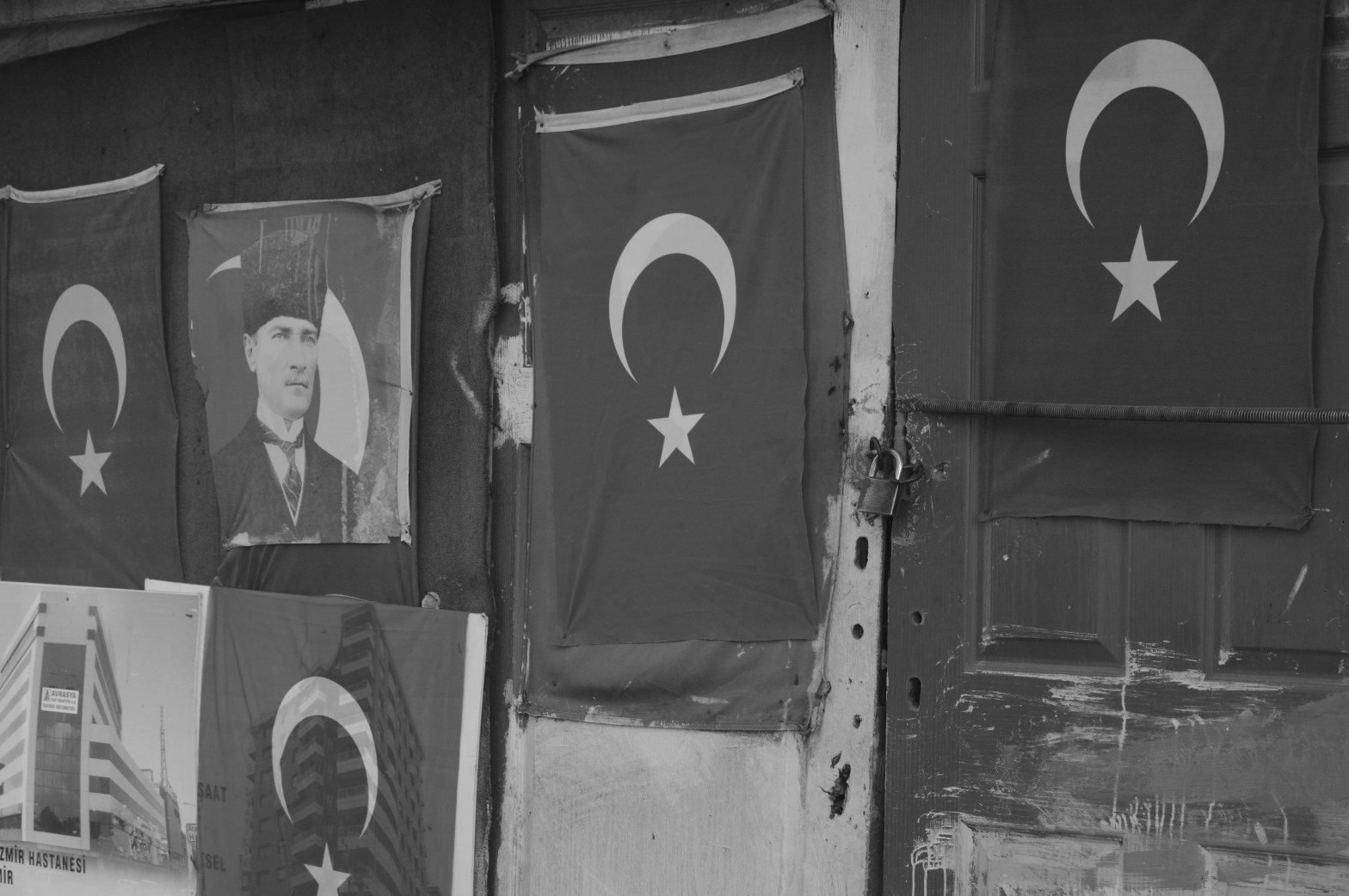
I became familiar with Atatürk’s face before knowing any of this information. The presidential photograph of the ‘Father of modern Turkey’ decorates bars, gift shops, street corners, and restaurants. The national identity originating with Atatürk’s presidency is widely celebrated.

As for Christos, he eventually immigrated to the United States and opened up an advertising firm in New York City. Harry’s trip, emotional and inspiring, was coming to an end. He was headed back to Greece that night, but he assured me he would be back. Before we parted ways I asked if it was okay that I took communion despite not being Greek Orthodox and he assured me that that was definitely against the rules. There was no turning back now, I had chosen a life of crime. I made my great escape back into the fast moving heat of Istanbul streets.
Horse Meat and the Quran

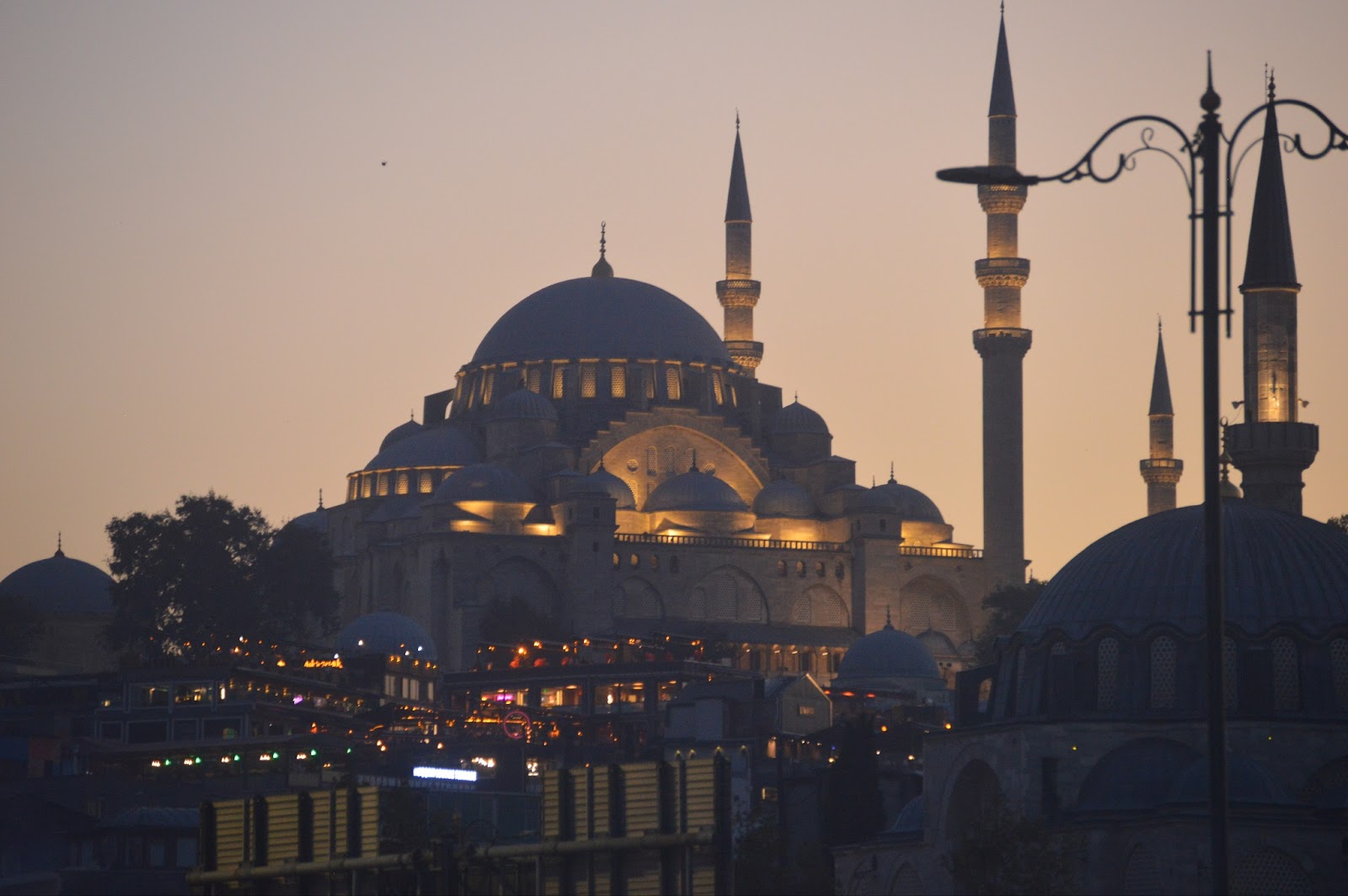
I first saw The Suleymaniye Mosque illuminated by a projector’s glow during a lecture on Islamic Architecture. I learned that The Mosque was commissioned by Ottoman ruler Suleiman the Magnificent in 1557 and was designed by his chief architect: Mimar Sinan. 

Sinan, responsible for many 16th century mosques, palaces, madrassas (Islamic schools) bathhouses, and bridges is a widely celebrated Ottoman architect. Sinan became a part of the household military beneath the Sulemaine at a young age through a draft system known as Devshirme (translated to child levy). The Devshirme system took children from Christian families in the Balkan region (Armenians, Croats, Greeks, Bulgarians), converted them to Islam, educated them on Ottoman customs, and trained them to fight for the empire that took them from their homes. 

In my mind this looks like an example of Stockholm syndrome- when hostages, through psychological manipulation, begin to feel a kinship to their captors, even going to the extreme of defending and protecting them. However, maybe leaving the impoverished villages of the Balkan region to serve the Sultan was seen as a benefit, despite the noble feat you’d need to concur in order to join: circumcision at age fifteen. 

This painful image was not at the forefront of my mind while I removed my shoes before entering the Suleymaniye Mosque. Instead, I tuned into the silence, the feeling of the carpet on my feet, the wide open space, and the symmetry beginning at the floor and leading upward to a dome illuminated by light.   

I found myself in front of a table decorated with stacks of informational books on Islam “Are you looking for English literature?” said a man wearing a name tag. I was taken aback by his assumption.

Usama had a warm glow to him and I immediately felt he was a kindred spirit. He was a 20-something-year-old from India, studying journalism at Istanbul University, and volunteering at the mosque in his free time. He wondered what I knew about Islam, and I admitted that I did not know much. 

We sat down in the middle of the mosque and paged through a Quran together. It had been years since I sat criss-cross with my shoes off and bent over a book. I felt like a kid again- young, impressionable, and vulnerable in front of 604 pages of philosophical messages transmitted across 1400 years of human history. As Usama moved through the pillars of Islam, read verses, told stories, and fueled me with metaphysical ideas, my head began to swim in that big empty space.

“Ayat means a truth or miracle.” Every line in the Quran is an Āyah. The angel Gabriel coming down to greet Muhhamed is an Āyah. The fact that I met Usama is an Āyah. For Usama, this word could be applied to all things he saw and touched, as it described his individual relationship with Allah. 

“We will show them Our signs in the universe and in their own selves, until it becomes manifest to them that this (the Quran) is the truth” (Quran; 41:53).

Allah, the Arabic word for God, is a genderless pronoun that describes the omnipresent, timeless, bodiless, fabric of the universe. Allah, never born nor will ever die, is the truth behind reality. An eternal, transcendent, all-knowing source of creation. 

The knowledge from our creator, Allah, could be found within the Quran he explained while using his hands as if the truth were within them. I smiled while looking down at the book resting in front of my sweaty socks. I wondered if it could really be that simple. 

I was reminded that I would not know the true word of god unless I spoke Arabic, so I’d better start studying. Similarly, I will never read a “true” Dostoevsky novel unless I learn Russian. A translation of the truth is the best attempt to move symbols from one language system to the next without changing their meaning. Yet we decided that still, the truth lies beyond symbolism, beyond words, and language.  

Joseph Campbell wrote, “the best things cannot be told, the second best things are misunderstood.” Communication, the articulation of thoughts, is always merely an attempt to translate indecipherable things into reality. This is one of my favorite quotes by a Vietnamese Buddhist monk that I feel articulates this idea: 

“The teaching is merely a vehicle to describe the truth. Don’t mistake it for the truth itself. A finger pointing at the moon is not the moon. The finger is needed to know where to look for the moon, but if you mistake the finger for the moon itself, you will never know the real moon.”

– Thich Nhat Hanh

Soon our conversation began to bend away from spirituality. I asked Usama about his interest in journalism, his life in India, and his social life in Istanbul. He explained that the mosque had a large volunteer community that cooks and hangs out together. In fact, the previous night he had made Biryani for everyone. Similarly, that day, a Russian member’s mother was in town and she had prepared a Dagestani regional dish.

“I ate horse meat today!” laughed Usama with a wide-eyed grin.  

“That’s wild,” I replied. 

“You want some?” 

“Of course!”

That’s when I learned about Dagestan, an Islamic region of Russia, and the fact that horse sausage is commonly eaten in parts of Central Asia.

Moments later we were off. I put my shoes on at the steps of the mosque. Usama was just ahead of me, and I followed with my new Quran under my arm. We walked beneath voluminous trees in the mosque’s courtyard and then underneath an archway leading us back onto the surrounding cobblestone streets. Just a bit further was a white brick two-story building. We went inside. The foyer had dimmed lighting and was decorated with dark wood. We entered a well-lit kitchen filled with light chatter and the washing of dishes. Usama introduced me to some people in passing before ushering me into a tiny courtyard behind the building. I sat at a long table, surrounded by cobblestone walls that were covered in leafy vines, and waited for my horse.

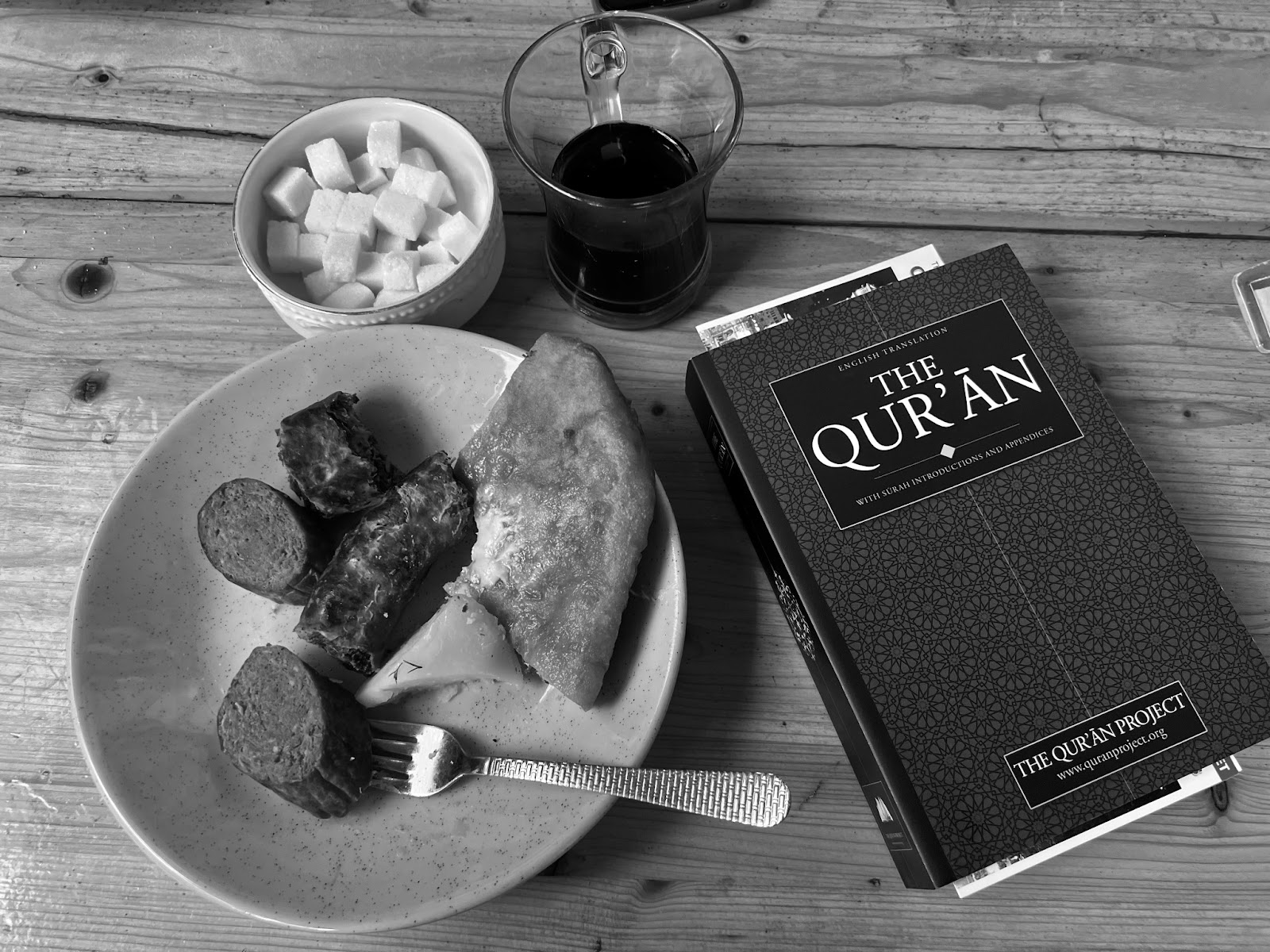
The Horse Sausage was pinkish, served alongside blood sausage, potato, a slice of buttered pastry, and of course a Chai. A dug in. It was salty and tender and I could imagine the wild Russian beast galloping across a golden plain only to be slaughtered by a pack of babushkas. The blue sky above my head was an Āyah along with my table of new friends, possibly too entertained by the American eating an animal that in his country, was traditionally rode rather than eaten. I didn’t have to fake any facial expressions of satisfaction. I was hungry and the meat could have passed for pork. Of course, for everyone I was sitting with, pork was “Halal” or forbidden.

Horse Meat, pastry, chai, and holy book

Over the course of my stay, I was introduced to Muslims from around the world. Many of them were generous enough to point out their favorite verses in the Quran and even recite them for me. By the end of my stay, I felt intoxicated by long winding conversations about religion. As I parted ways with Usama I gave him many thanks for the experience. It was just another day for him and so he shrugged his shoulders and smiled.  

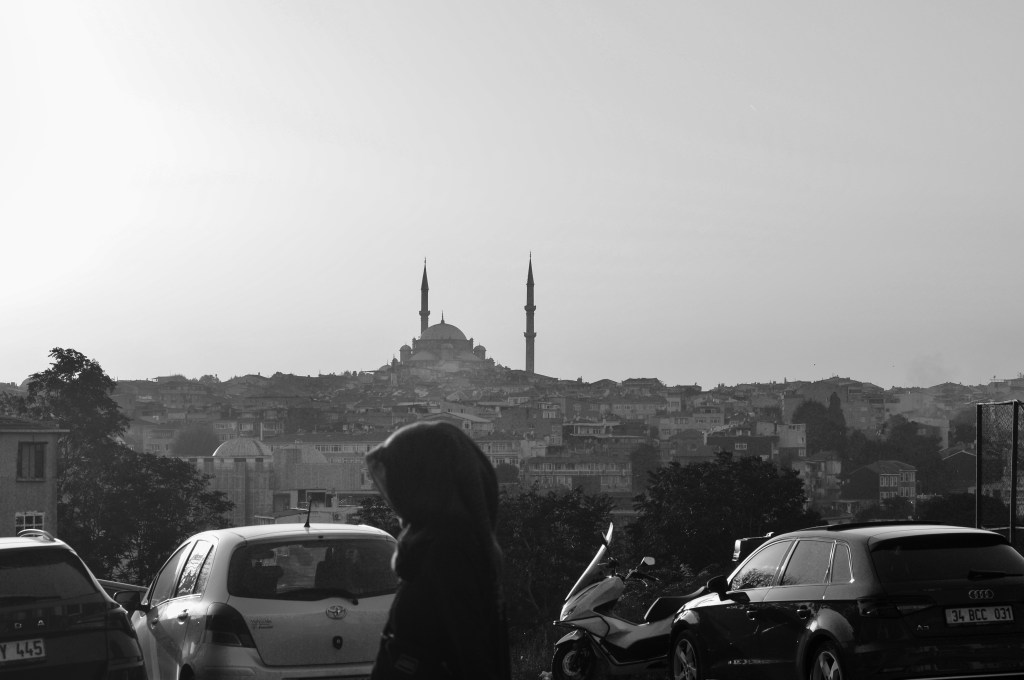
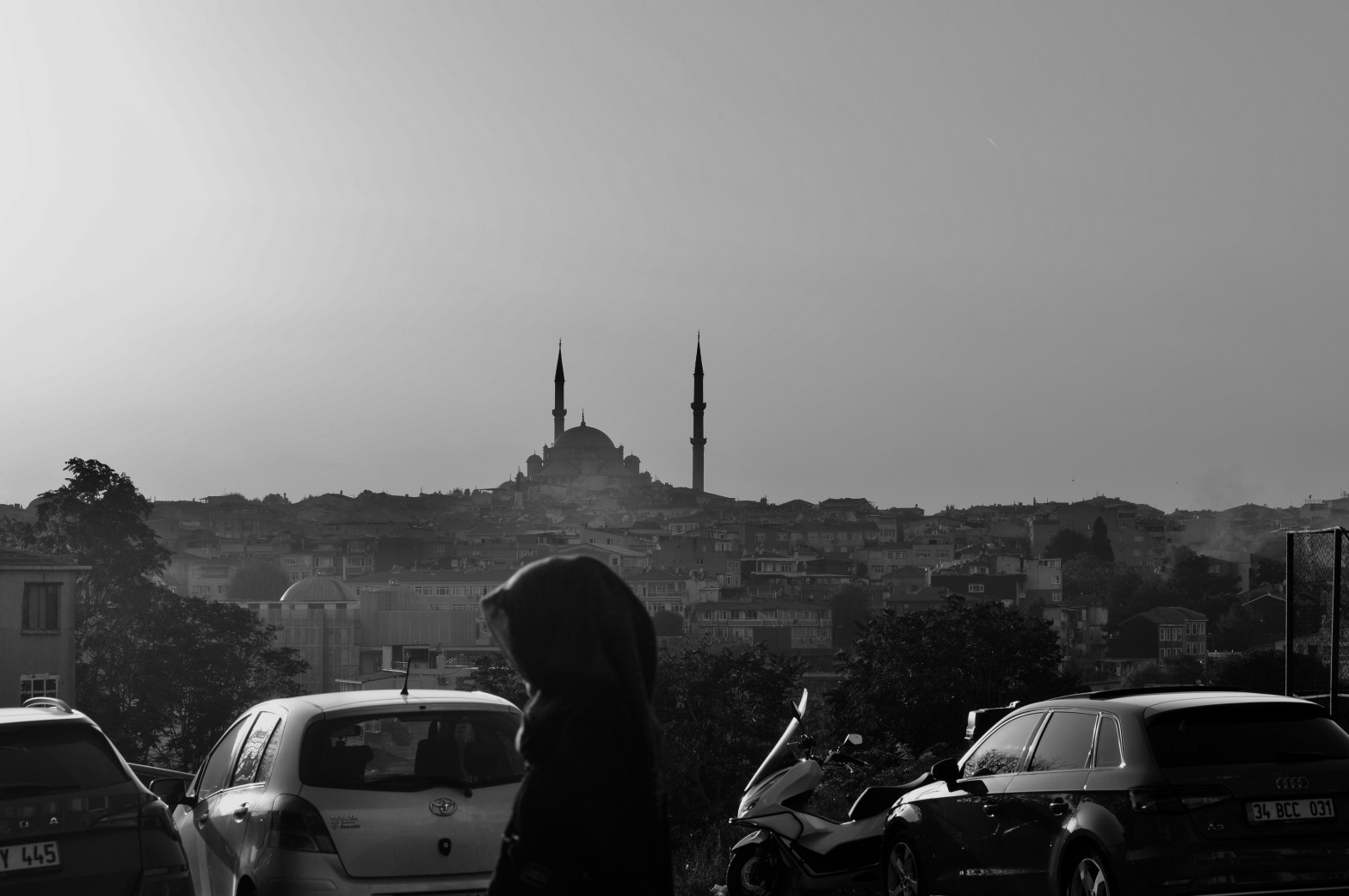
Outside, Istanbul’s cream-colored corridors had turned golden as the sun set. I started walking with a newfound attention to the details around me. I saw in the far distance a mosque’s hazy silhouette with its dark rounded central dome, a ring of smaller domes, and towering minarets. In the foreground was an old woman, hidden beneath a hijab pulling a cart along the uneven road. I began following her down a hill. A motorbike rushed past us and I could feel the vibration. Everyone was headed home from work. 

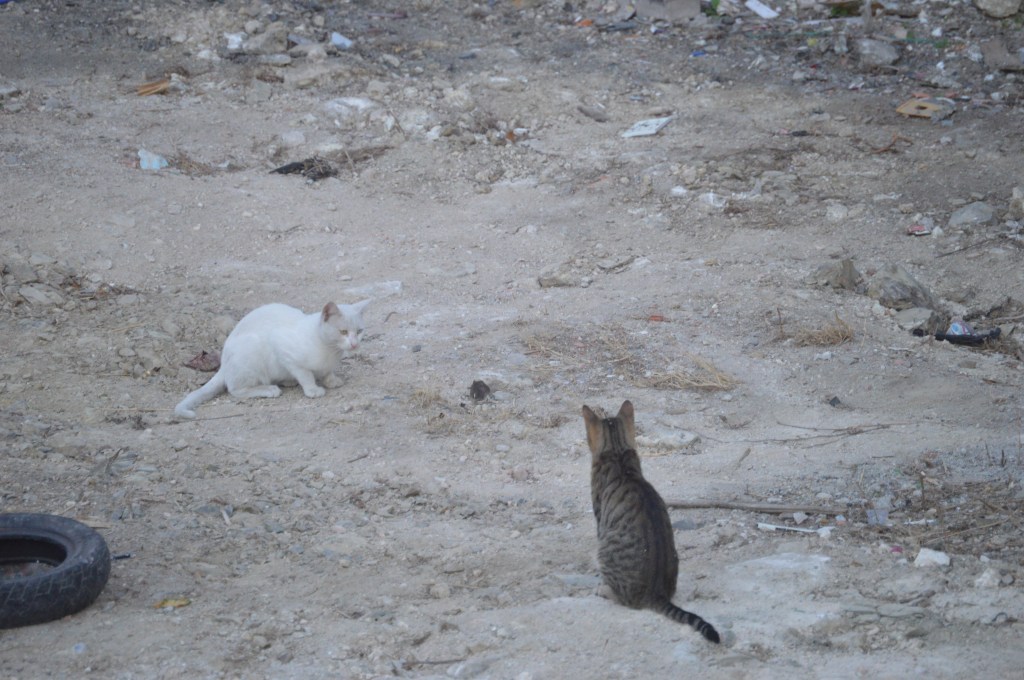
The layers of the city stacked on top of one another without apology. I walked past chipped brick, crowded cemeteries, clothing lines, and an idling backhoe. I saw rows of apartment buildings, none unique from the other, and in the distance an uncountable number of skyscrapers shining like a wall of glass. This was a reminder of the city’s modernization. Yet, beneath me, in a pit of rubble, were two cats. One was white while the other was gray, and between them was a gray mouse. They took turns pouncing on the mouse and then releasing him. I watched the medieval game of catch and release for a couple of minutes before moving on.

I saw the skeleton of an abandoned apartment building with one of its third-story rooms exposed by a downed wall. I used my camera lens to get a closer look. The remaining light of the day shined perfectly into the space, causing its contents to glow. A plastic red chair was bellied up to a desk. Next to it, was a miniature city of empty vodka bottles, their necks looking like tiny minarets. To their left was a gray pair of new balance sneakers. It left me with more questions than answers.

As I returned to the beaten path, I saw two women wearing hijabs and three kids sitting on the asphalt between two parked cars. They were digging through a garbage bag and eating the contents within. Yet, just beyond this was a waterfront bustling with carts of street food feeding hungry tourists. And just beyond that was a bridge with about one-hundred fishing poles cast at different angles. I found these images to be yet another example of Istanbul’s complex and changing nature.

I walked across the Galata bridge, over the Bosphorus, leaving the golden glow of the Suleiman Mosque behind me. Busses hummed, railcars rushed past, taxis honked, and conversations in different languages filled the streets. Within this noise, I walked quietly while pondering the saltiness of horse sausage.

قُلۡ سِيرُواْ فِي ٱلۡأَرۡضِ فَٱنظُرُواْ كَيۡفَ بَدَأَ ٱلۡخَلۡقَۚ ثُمَّ ٱللَّهُ يُنشِئُ ٱلنَّشۡأَةَ ٱلۡأٓخِرَةَۚ إِنَّ ٱللَّهَعَلَىٰ كُلِّ شَيۡءٖ قَدِيرٞ

“Travel through the land and observe how creation began. Then Allah will produce the final creation. for Allah has power over all things.”

Profile on Ukrainian Family Relocated to Wisconsin

5,035 miles from the bustling capital of Ukraine sits an unassuming ranch-style home in tranquil American suburbia. Its placement in Stoughton, Wisconsin, amongst rows of shriveling corn stalks in early Fall, is not unordinary, however, the Ukrainian flag hanging near the door is a less common sight. 

On the 24th of February, 2022, the Babych family awoke to the sound of falling bombs in Kyiv. Discussion of Russian presence in the East had been a topic of conversation in previous weeks, however, hope that Putin’s claims were merely a threat trumped intensive preparation. 

Kay Weeden, a resident of Stoughton Wisconsin, has had experience working with victims of unforeseen loss during her time volunteering with the Red Cross. As American media broadcasted images of dark smoke on the Ukrainian cityscapes, humanitarian-minded individuals such as Weeden knew aid would be needed. It would take radical collectivism. 

“I wanted it to be something that could benefit a few people, but I had no idea that it would turn into this,” said Weeden, founder of Stoughton Resettlement Assistance Program.

“Boom,” voiced Jenya, father of two and former car parts salesman in Kyiv. “Boom,” he repeated in intimidation of Russian artillery. Sitting at a table within his Stoughton home, Jenya expanded his hands over the wooden tabletop surface in an attempt to gesticulate the magnitude of the morning explosions. The dining room was silent as his description evoked painful memories of abrupt violence. 

Around 4 AM, an apartment building crumbled as flames seeped through its pours in the morning’s darkness. The ghostly wail of sirens echoed through a city whose civilians were rising earlier than usual. The nation’s attention turned to the television and social media for answers. 

In the following hours, similar explosions were reported across the country indicating a synchronized network of aggression. The Ukrainian Ministry of Defense made an announcement via telegraph that Russian aerial strikes were targeting airports. The Health Minister reported that hospitals were being targeted. President Zelensky appeared on televisions screens urging citizens to stay within their homes, stating, “we will not put down weapons, we will defend our state”

As city officials urged citizens to stay away from windows, Jenya and his wife Katya grabbed what they could. The couple gathered their children, Nazar and Dianna, and made phone calls to friends and family, equally overcome by the imminent implications of martial law. 

Katya recalled observing her husband pack one pair of clothes, and feeling the bitter necessity to remind him that their departure from the city could last more than one night. Katya wondered if her advice was conceived by pessimism or rationalism. Nevertheless, unanswerable questions lingered as the family shut the door to their home behind them.

Where will we sleep tonight? How long will this last? Why is this happening? 

Civilians asking similar questions filled the streets of Kyiv on the 24th of February. Individuals boarded trains, checked bus schedules, and loaded what they could into cars in an attempt to desert the city. A collective tension heightened as pressure to leave increased. Russians fired weapons in the East. 

Jenya nodded in agreement as Katya set the scene from across the table. Brief intermissions, as she searched for the appropriate translation, were followed by passionate descriptions. She described traffic stretching throughout the city, cars at a standstill, and the feeling of discomfort while being stuck. The emergence of tanks was a distressing sight that evoked cynicism. Meanwhile, petrol stations and grocery stores became ghost towns as preparation for potential lockdown began. It seemed the issue at hand would last longer than one day. 

500 kilometers to the West, on the Polish-Ukrainian border, a line began to form at border control. Automobiles filled with Ukrainain’s fleeing their homes with the possessions they could carry stretched 5 miles in length. Some abandoned their cars and took to foot. 

Jenya and Katya explained that the trip took nearly a day due to traffic, rather than the usual eight hours. After great length, immense patience, and suffocating anxiety, the family was turned away.     

“We cried, we didn’t understand what was next,” said Katya Babych, acting as the representative for her family due to her impressive proficiency in english. 

Ambushed by an unforeseeable reality, Jenya and Katya spent countless hours researching and making phone calls to potential places of refuge. Google Maps became littered with tiny green pins across Eastern Europe indicating temporary options. However, as the UN announced over 100,000 Ukrainian citizens had fled their homes, the number of available beds diminished rapidly.   

“One month ago we have work, home, friends, food, but now we don’t have,” said Katya as she described the unimaginable feeling of abandoning home. Even now, while living in Stoughton, an inability to process the immediate loss remains. However, as material possessions have proven to be replaceable, separation from family remains the most difficult. Katya was able to travel to the US with her mother, however due to poor health conditions, her father was forced to remain in Ukraine. 

As news coverage documented a progressively worse conflict, Ukraines neighboring country Moldova became an alternative, temporary, host country for the Babych’s. This was followed by a period in Poland with 25 Ukrainian families at a private Christian camp. In Czechia, Jenya found temporary work, while Katya helped teach the children, reminiscent of her job in Kyiv as a teacher at a private Christian school. 

During this time, Stoughton Resettlement Assistance Program was conceived nearly out of thin air. In the process of working with Afghan refugees at Fort McCoy, Weeden attempted to help resettle an individual. When the plan fell through, Weeden was left with two empty apartments. Soon after, a Ukrainian family seeking a home arrived in the Madison area, and the apartments were filled .  

As Czechia’s winter dissipated into Spring, the Babych family again began to question what was next. The recurring realization of uncertainty was exhausting. Every place they called home had unignorable impermanence. 

Katya reflected on the difficulty of explaining to her children their inability to return home, see friends, or remain in one place. The mother’s voice cracked thinking about her daughter Dianna’s question, “where is the next place where I can sleep?”

Hope came on April 21, 2022, when President Biden committed to granting temporary residence in the United States to 100,000 Ukrainian refugees. 

The State Department of the United States requires that Ukrainians gain sponsorship, follow health requirements and that they pass various background screenings. The permission to live and work within the United States will be re-evaluated in two years upon arrival. In the meantime, the Babych’s were connected with a host family in Oregon, Wisconsin. 

Soon, Weeden became connected with the family and prepared to, once again, take a family under her belt. Katya and Jenya moved into their Stoughton home with their children, Katya’s brother, her sister-in-law, and her mother. The room’s void of decoration mirrored the uneasy feeling of beginning again. Yet, the Ukrainian flag, unpackaged, and hanging next to the front door deemed the residence a home.  

“It’s given a real dose of what it’s like to try to manage somebody’s life from the moment they step into the country until they can become self-sustaining,” said Weeden. 

Through self-starter fundraising, charitable donations from Stoughton residents, and organized events such as Ukrainian night, SRAP has been able to successfully aid the Babychs and other families in their transition. Five leases and eight families later Weeden’s life has become fully occupied with her resettlement program. A goal amongst Weeden and her team has been to make the families feel as if their culture is welcome within the community. 

“We want to get to know their traditions, their history, their art, their music, the food they enjoyed, and vice versa, but it was really for us to get to know them,” said Sharon Mason-Boersma, founder of SRAP among Weeden, who has helped to organize fundraising events in the community.  

In the process of settling, the Babych family adjusted to the oddities of American culture. Katya wondered about the mysterious tradition known as Halloween and its grim decorations, how to make the ‘th’ sound in the English language, pondered the invention of canned soup, and the abundance of frozen meals within America’s grandiose supermarkets. 

Since its conception, SRAP has gained 501(c)(3) status, giving the non-profit the ability to receive tax deductible donations and apply for grants. Weeden said that gathering donated clothing, food, and even automobiles emitted “positivity in a world where everything was going South fast.”

The process, however, has not been free from difficulties. Immigration to the US is not a simple or generally friendly process. Weeden said that working with the Ukrainians has illuminated the lack of resources available for individuals seeking a new start in the states. For this reason, the Babych’s, among other families, are thankful for the community’s aid. 

“It’s been fabulous, it’s been encouraging, it’s been rewarding, and it’s been absolutely overwhelming for those reasons,” explained Weeden. 

While the Babych family have experienced momentary relief, in their home country Ukrainian flags still fly half-mast. Russian attacks on the Ukrainian power grid have caused the normalization of electricity blackouts and water shortages. While speaking with foreign leaders in an attempt to garner international aid Zelensky asserted that generators are now “as necessary in Ukraine as armored vehicles and bulletproof vests.”

According to the UN, 6755 civilians have been senselessly killed in Ukraine. Mykhailo Podolyak, an adviser to Ukrainian President Zelensky, said between 10,000 and 13,000 troops have died defending the country. “In these times of suffering and darkness, it is so important to bring light to Ukraine,” said European Commission President Ursula von der Leyen.

Many Ukrainains still seek refuge abroad. Tanya, Katya’s sister-in-law, is in the process of finding an affordable apartment for her family who is set to come to the US within the coming months. For the Babych family, this news was light in an era of darkness. 

Six-year-old Dianna now knows where she will be sleeping tonight, however, the Babych family is continually reminded of the looming uncertainty manifesting in their future. A weight reserved for two parents attempting to remain strong for their children. For now they wait, grasping onto stability where they can find it. 

Learning English has been something to hold onto. Spending five to six hours a day studying at the Wisconsin ESL Institute in Madison, the adults in the family have gradually increased their fluency. Now with work permits, Jenya and Katya plan to seek work within the new year.

Katya explained that it has been amazing to watch her five-year-old daughter Dianna pick up the language as she entered kindergarten. Nazar, in 6th grade, has also been tasked with the daunting goal of starting a new school, making new friends, and playing team sports while communicating in a second language. 

“It’s a very interesting time, my kids go to school and we go to school. They help me with my homework and I help my kids with their homework,” said Katya. Her optimism, and ability to maintain a sense of humor is admirable. “I hope, I pray, but I don’t know,” is a recurring conclusion when considering the unknown hurdles that lie ahead, when imagining her children’s future, when thinking about her father in Ukraine. For now, the Babychs wait, with a Ukrainian flag masted proudly on their front porch, an ever-present reminder that their only option is hope.   

A Contemporary Circus

The common idea of a circus, often instilled within us early by cartoons and Hollywood, contains big top tents, fashionable elephants, and white-faced clowns. While this world exists, it’s attendance is waning amidst shifts in consumer concerns and attention. A stand-out reasoning the publics’ concerns regarding the safety and morality of animal performers. In 2011, the USDA fined Ringling Bros. and Barnum & Bailey Circus $270,000 for allegedly violating the Animal Welfare Act. Subsequently, In 2017, after 146 years of performances, the world-renowned circus production company closed its doors for the final time. While disheartening for lifelong fans, this news came without shock for those who have turned their eyes and wallets to other forms of entertainment. 

Yet while film and television dominate, the visual art of circus performance remains within the physical world; varying in style and magnitude. Roland Berg, a trapeze artist who trained with Circus Juventas in Minneapolis, is a practitioner of the circus arts. While he trained at one of the largest circus schools in the country, many, including those living in the Minneapolis area, fail to recognize the name according to Berg. Berg explained that he is all too familiar with misconceptions and misrepresentations of the circus. One of these in particular included the lack of understanding amongst viewers regarding the amount of work put into a performance. 

Trapeze is an aerial act often including several individuals swinging between platforms and performing poses or tricks in between. Berg explained the importance of being physically fit to move your body in ways one usually doesn’t. “You are working very hard in order to make your performance look easy,” said Berg, “it is like a sport in the sense that it is truly physically demanding.” The work is not singular however. According to Berg, your fellow performers are like your teammates. Therefore everyone is responsible for one another’s success and most importantly, their safety.  

This work pays off in the two weeks of May that Circus Juventas performs. The show consists of aerial, acrobatic and balance acts. In this time, eyes gleam with excitement amongst the fans as Berg daringly flys through the air. This astonishment when watching circus causes the viewers  to be totally immersed, says Maika Isogawa, former Cirque du Soleil performer. “The creativity of it transports you into another world,” said Isogawa.

Creativity is an understatement for the work and goes into a performance. At Circus Juventas, theater classes are taken so performers can work on character building. This is also replicated at the Cirque du Soleil’s training facility in Montreal where athletics and art share relevance. In this place, costume designers, choreographers, and theater coaches alike work with performers to push the artistic portion of the show. 

Attracting 150 million spectators a year and grossing $1 billion annually, the stakes to design an entertaining experience are high for the Cirque du Soleil company. However, with 19 performances worldwide that travel to 300 cities, it seems the ink is yet to run dry. Instead, fans have been continually reminded of Cirque du Soleil’s original thinking and innovation. In recent years the company has produced an adaptation of James Cameron’s film Avatar, a Beatles tribute show and O, which is a water-themed stage production. These productions are dazzling with lights, projections that adapt to performers, and live music. “[They are] pushing boundaries when it comes to innovation and what you can do with a performance,” said Isogawa.       

While working with Cirque du Soleil, Isogawa adopted the names “Beach Girl” and “The Pink Lady.” These names were used to describe her character in the show Totem. Totem’s theme revolved around human evolution. “One component of modern circus arts is the artistic portion of it. It’s not entirely doing incredible feats…now art, expression and beauty is integrated into it,” said Isogawa.          

Antóin Gorman, a professional clown, certainly agrees with the idea that expressionism, art, and beauty are synonymous with performance. Gorman described the process of transforming into a character as self-reflective and hypnotic. “It feels like glitter is going over you. Your senses are stronger. The moment I’m a clown I can hear better, I can smell better, everything is just better. You are very aware,” said Gorman. While interviewing Gorman, I was able to witness this when he  introduced me to his character Tizzy. In a matter of seconds, Gorman unlocked his child-like curiosity and the adult man I had been talking to for the past 20 minutes no longer existed. “At some point, we were told in our lives that we are not allowed to play anymore,” said Gorman. To Gorman, clowning is a rejection of this oppressive idea.  

Gorman compared the art form of clowning to the invention of the novel. While its popularity has been fading for 200 years, through adaptation and transformation, the novel remains important to many. “The idea of the clown is not going away, whether or not we associate it as a clown, it is still going to be there,” Gorman said. This idea is synonymous with the entirety of  contemporary circus. As the world changes, definitions and meanings of artforms shift. So while the stereotypical image of circuses may disappear, alternative forms of entertainment and aimed at immersing an audience will always remain.

This is incredibly important in a time when the idea of being entertained has become far less important than public safety. Gorman believes a renaissance is soon to follow after the pandemic subsides. Perhaps when that time comes, the lesser-known world of contemporary circus will experience a newfound appreciation. In this process, one can predict the artforms will gain greater representation as individuals seek out a way to feel like a child once again.