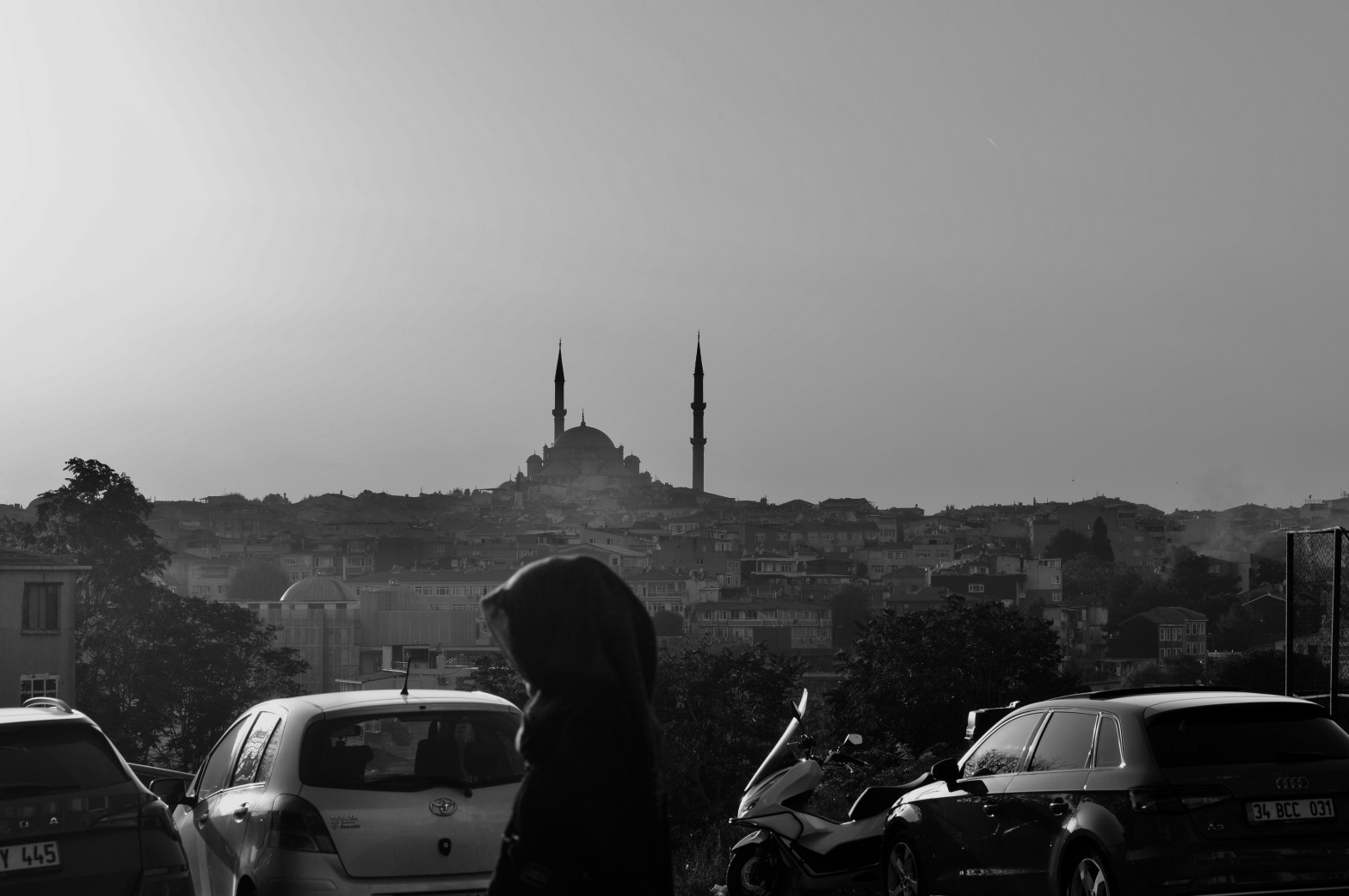
I first saw The Suleymaniye Mosque illuminated by a projector’s glow during a lecture on Islamic Architecture. I learned that The Mosque was commissioned by Ottoman ruler Suleiman the Magnificent in 1557 and was designed by his chief architect: Mimar Sinan.
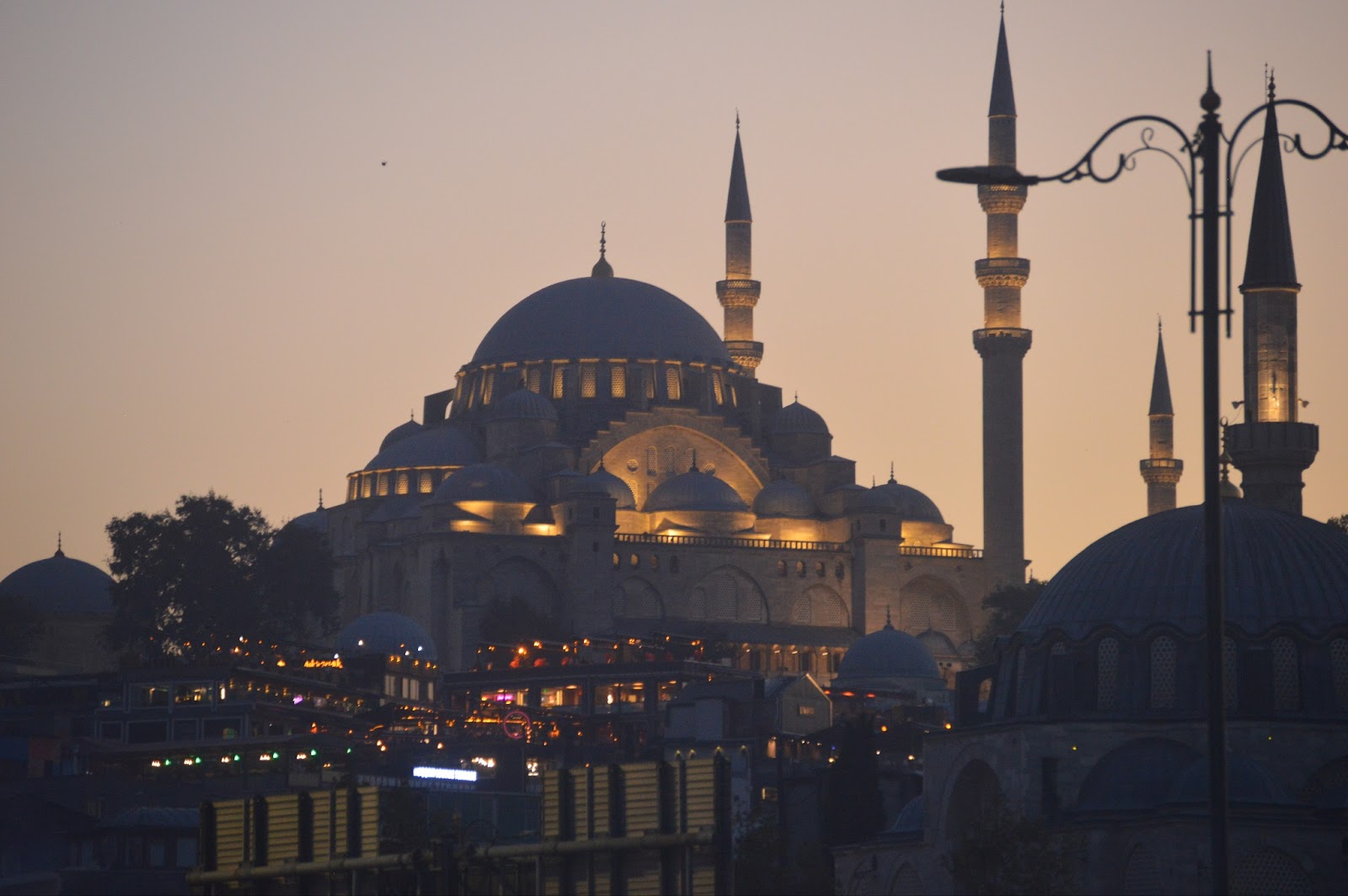
Sinan, responsible for many 16th century mosques, palaces, madrassas (Islamic schools) bathhouses, and bridges is a widely celebrated Ottoman architect. Sinan became a part of the household military beneath the Sulemaine at a young age through a draft system known as Devshirme (translated to child levy). The Devshirme system took children from Christian families in the Balkan region (Armenians, Croats, Greeks, Bulgarians), converted them to Islam, educated them on Ottoman customs, and trained them to fight for the empire that took them from their homes.
In my mind this looks like an example of Stockholm syndrome- when hostages, through psychological manipulation, begin to feel a kinship to their captors, even going to the extreme of defending and protecting them. However, maybe leaving the impoverished villages of the Balkan region to serve the Sultan was seen as a benefit, despite the noble feat you’d need to concur in order to join: circumcision at age fifteen.
This painful image was not at the forefront of my mind while I removed my shoes before entering the Suleymaniye Mosque. Instead, I tuned into the silence, the feeling of the carpet on my feet, the wide open space, and the symmetry beginning at the floor and leading upward to a dome illuminated by light.
I found myself in front of a table decorated with stacks of informational books on Islam “Are you looking for English literature?” said a man wearing a name tag. I was taken aback by his assumption.
Usama had a warm glow to him and I immediately felt he was a kindred spirit. He was a 20-something-year-old from India, studying journalism at Istanbul University, and volunteering at the mosque in his free time. He wondered what I knew about Islam, and I admitted that I did not know much.
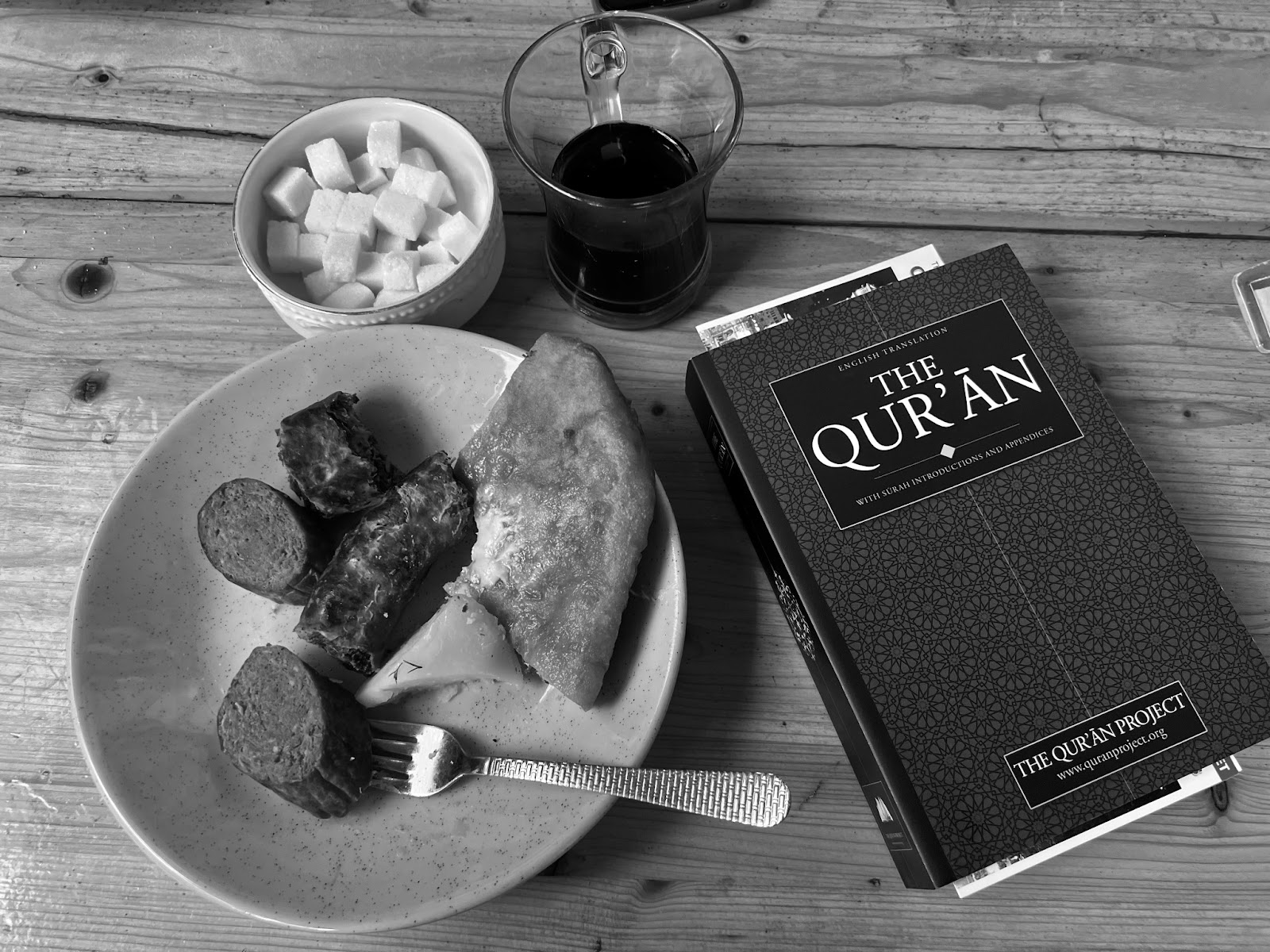
We sat down in the middle of the mosque and paged through a Quran together. It had been years since I sat criss-cross with my shoes off and bent over a book. I felt like a kid again- young, impressionable, and vulnerable in front of 604 pages of philosophical messages transmitted across 1400 years of human history. As Usama moved through the pillars of Islam, read verses, told stories, and fueled me with metaphysical ideas, my head began to swim in that big empty space.
“Ayat means a truth or miracle.” Every line in the Quran is an Āyah. The angel Gabriel coming down to greet Muhhamed is an Āyah. The fact that I met Usama is an Āyah. For Usama, this word could be applied to all things he saw and touched, as it described his individual relationship with Allah.
“We will show them Our signs in the universe and in their own selves, until it becomes manifest to them that this (the Quran) is the truth” (Quran; 41:53).
Allah, the Arabic word for God, is a genderless pronoun that describes the omnipresent, timeless, bodiless, fabric of the universe. Allah, never born nor will ever die, is the truth behind reality. An eternal, transcendent, all-knowing source of creation.
The knowledge from our creator, Allah, could be found within the Quran he explained while using his hands as if the truth were within them. I smiled while looking down at the book resting in front of my sweaty socks. I wondered if it could really be that simple.
I was reminded that I would not know the true word of god unless I spoke Arabic, so I’d better start studying. Similarly, I will never read a “true” Dostoevsky novel unless I learn Russian. A translation of the truth is the best attempt to move symbols from one language system to the next without changing their meaning. Yet we decided that still, the truth lies beyond symbolism, beyond words, and language.
Joseph Campbell wrote, “the best things cannot be told, the second best things are misunderstood.” Communication, the articulation of thoughts, is always merely an attempt to translate indecipherable things into reality. This is one of my favorite quotes by a Vietnamese Buddhist monk that I feel articulates this idea:
“The teaching is merely a vehicle to describe the truth. Don’t mistake it for the truth itself. A finger pointing at the moon is not the moon. The finger is needed to know where to look for the moon, but if you mistake the finger for the moon itself, you will never know the real moon.”
– Thich Nhat Hanh
Soon our conversation began to bend away from spirituality. I asked Usama about his interest in journalism, his life in India, and his social life in Istanbul. He explained that the mosque had a large volunteer community that cooks and hangs out together. In fact, the previous night he had made Biryani for everyone. Similarly, that day, a Russian member’s mother was in town and she had prepared a Dagestani regional dish.
“I ate horse meat today!” laughed Usama with a wide-eyed grin.
“That’s wild,” I replied.
“You want some?”
“Of course!”
That’s when I learned about Dagestan, an Islamic region of Russia, and the fact that horse sausage is commonly eaten in parts of Central Asia.
Moments later we were off. I put my shoes on at the steps of the mosque. Usama was just ahead of me, and I followed with my new Quran under my arm. We walked beneath voluminous trees in the mosque’s courtyard and then underneath an archway leading us back onto the surrounding cobblestone streets. Just a bit further was a white brick two-story building. We went inside. The foyer had dimmed lighting and was decorated with dark wood. We entered a well-lit kitchen filled with light chatter and the washing of dishes. Usama introduced me to some people in passing before ushering me into a tiny courtyard behind the building. I sat at a long table, surrounded by cobblestone walls that were covered in leafy vines, and waited for my horse.
The Horse Sausage was pinkish, served alongside blood sausage, potato, a slice of buttered pastry, and of course a Chai. A dug in. It was salty and tender and I could imagine the wild Russian beast galloping across a golden plain only to be slaughtered by a pack of babushkas. The blue sky above my head was an Āyah along with my table of new friends, possibly too entertained by the American eating an animal that in his country, was traditionally rode rather than eaten. I didn’t have to fake any facial expressions of satisfaction. I was hungry and the meat could have passed for pork. Of course, for everyone I was sitting with, pork was “Halal” or forbidden.
Over the course of my stay, I was introduced to Muslims from around the world. Many of them were generous enough to point out their favorite verses in the Quran and even recite them for me. By the end of my stay, I felt intoxicated by long winding conversations about religion. As I parted ways with Usama I gave him many thanks for the experience. It was just another day for him and so he shrugged his shoulders and smiled.
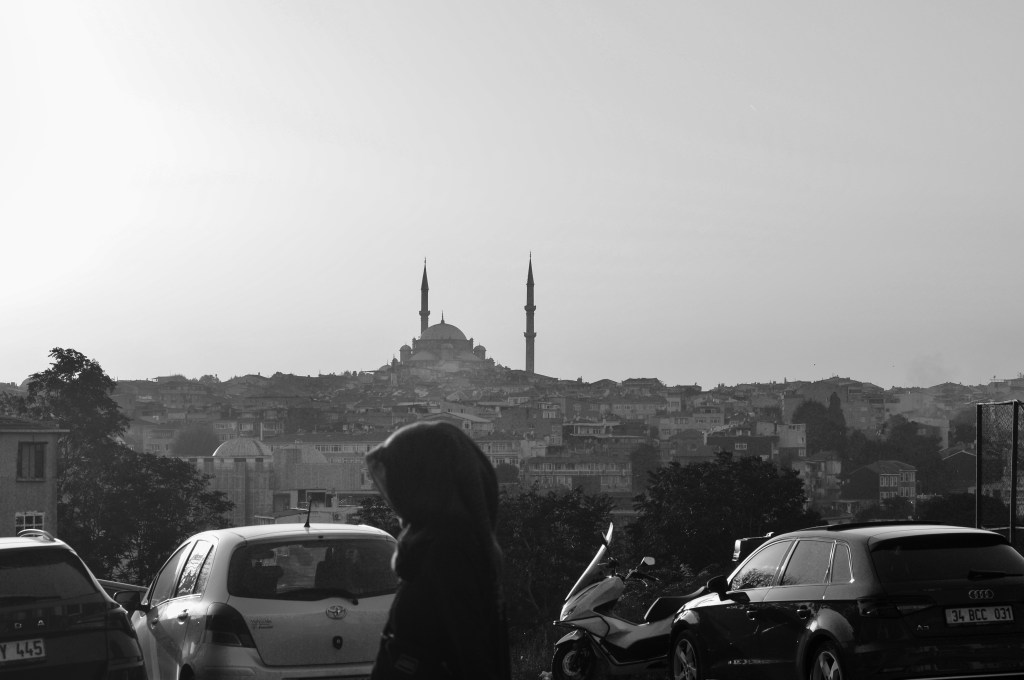
Outside, Istanbul’s cream-colored corridors had turned golden as the sun set. I started walking with a newfound attention to the details around me. I saw in the far distance a mosque’s hazy silhouette with its dark rounded central dome, a ring of smaller domes, and towering minarets. In the foreground was an old woman, hidden beneath a hijab pulling a cart along the uneven road. I began following her down a hill. A motorbike rushed past us and I could feel the vibration. Everyone was headed home from work.
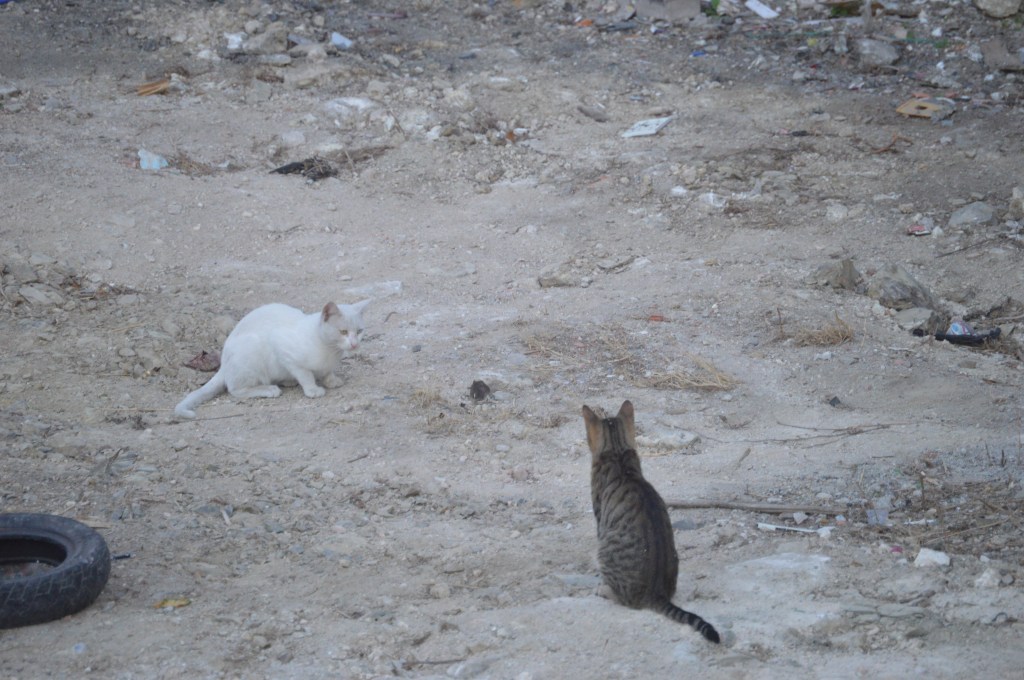
The layers of the city stacked on top of one another without apology. I walked past chipped brick, crowded cemeteries, clothing lines, and an idling backhoe. I saw rows of apartment buildings, none unique from the other, and in the distance an uncountable number of skyscrapers shining like a wall of glass. This was a reminder of the city’s modernization. Yet, beneath me, in a pit of rubble, were two cats. One was white while the other was gray, and between them was a gray mouse. They took turns pouncing on the mouse and then releasing him. I watched the medieval game of catch and release for a couple of minutes before moving on.
I saw the skeleton of an abandoned apartment building with one of its third-story rooms exposed by a downed wall. I used my camera lens to get a closer look. The remaining light of the day shined perfectly into the space, causing its contents to glow. A plastic red chair was bellied up to a desk. Next to it, was a miniature city of empty vodka bottles, their necks looking like tiny minarets. To their left was a gray pair of new balance sneakers. It left me with more questions than answers.
As I returned to the beaten path, I saw two women wearing hijabs and three kids sitting on the asphalt between two parked cars. They were digging through a garbage bag and eating the contents within. Yet, just beyond this was a waterfront bustling with carts of street food feeding hungry tourists. And just beyond that was a bridge with about one-hundred fishing poles cast at different angles. I found these images to be yet another example of Istanbul’s complex and changing nature.
I walked across the Galata bridge, over the Bosphorus, leaving the golden glow of the Suleiman Mosque behind me. Busses hummed, railcars rushed past, taxis honked, and conversations in different languages filled the streets. Within this noise, I walked quietly while pondering the saltiness of horse sausage.
قُلۡ سِيرُواْ فِي ٱلۡأَرۡضِ فَٱنظُرُواْ كَيۡفَ بَدَأَ ٱلۡخَلۡقَۚ ثُمَّ ٱللَّهُ يُنشِئُ ٱلنَّشۡأَةَ ٱلۡأٓخِرَةَۚ إِنَّ ٱللَّهَعَلَىٰ كُلِّ شَيۡءٖ قَدِيرٞ
“Travel through the land and observe how creation began. Then Allah will produce the final creation. for Allah has power over all things.”
 Projects by JT Schultz